
Exploring the Desert Agave: Unique Characteristics and Natural Habitat
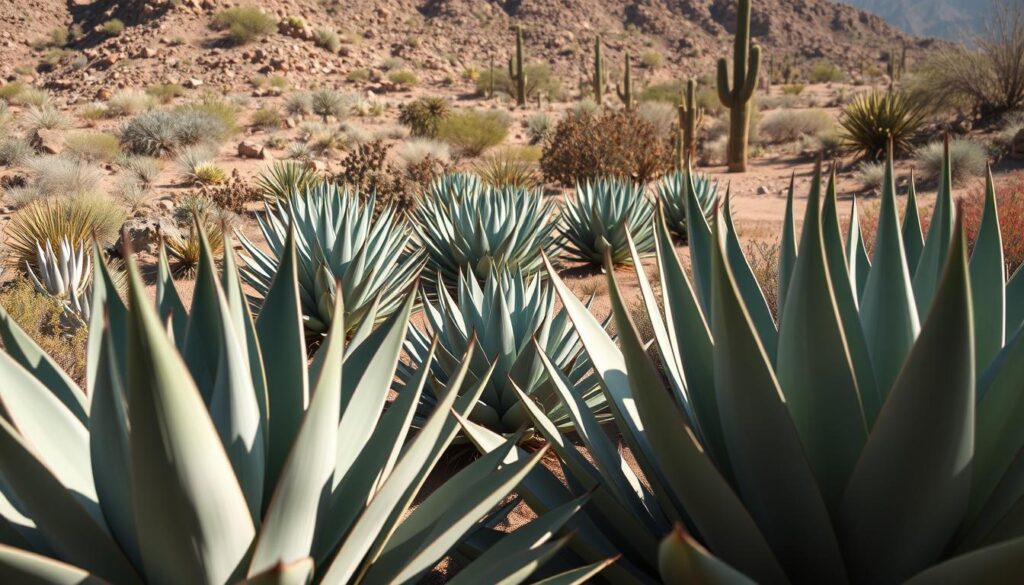
I collected a desert agave seedling from a Tucson botanical garden. The broad, gray-blue leaves formed a dramatic rosette with sharp spines and a saw-tooth margin that looks formidable even when small.
What makes the desert agave special? It’s incredibly drought-tolerant and slow-growing, then throws a tall stalk of yellow flowers when mature. Individual plants die after blooming, but the colony carries on. IMO it’s tough as nails.
Thinking of adding one? Those spines are no joke. Plant it away from walkways. Whether you’re in Southern California or another dry region, the desert agave is a stunning, low-maintenance choice.
The desert agave is a true marvel of nature. Known scientifically as Agave deserti, it builds a rosette of long, gray-green leaves edged with protective spines – a silhouette you can’t miss.
In the wild it grows on rocky slopes and desert washes across Southern California, Arizona, and Baja California. Those spots give the well-draining, arid conditions it craves. The plant often clusters while each rosette keeps its own character.
When mature, the flowers open on a tall spike. They pull in hummingbirds and insects, and the agave supports neighbors like creosote and shadscale. That’s why it’s a smart pick for waterwise landscapes.
Cultivating Your Agave Garden
Bringing the desert home is rewarding. Here are the essentials to grow this succulent well.
Essential Care Tips
- Plant in well-draining, rocky soil.
- Water sparingly – once a month once established.
- Give it full sun.
- Propagate by removing pups from the mother plant.
Soil, Water, and Sunlight
| Factor | Recommendation |
|---|---|
| Soil | Well-draining, rocky soil |
| Water | Minimal irrigation (once a month) |
| Sunlight | Full sun |
Follow that and you’ll build a thriving agave garden that echoes its natural home.
The History, Ethnobotany, and Uses of Agave
For centuries agave anchored culture and survival in arid regions. Its versatility made it indispensable.
Traditional Cultural Uses
Native Americans relied on agave for basics. They spun strong fibers into ropes and bowstrings and roasted the heart for food – a lifeline during droughts.
- Durable ropes and bowstrings.
- A roasted, nutritious food source.
- Beverages like pulque and mescal, big in Baja California and Arizona.
Modern Design and Conservation
Today the plant stars in gardens for its bold look and low water needs. Conservation groups protect wild populations and promote sustainable methods rooted in tradition.
- Bold aesthetics with water efficiency.
- Projects that preserve agave habitat.
- Old cultivation wisdom guiding new gardens.
From ancient uses to modern yards, agave bridges the past and present in landscape and conservation.
The Bottom Line
The desert agave thrives in full sun and rocky, fast-draining soil, with deep summer water and a dry winter rest. It’s beautiful, tough, and a symbol of resilience – and it pairs perfectly with eco-friendly gardening if you want to go greener.
Give it a shot. Plant one where the sun beats down and watch it do its thing with almost zero fuss. 🙂